
Government Vehicle Accident Lawsuit In 2026 - Get Maximum Compensation
Find out if you have a case
Free and confidential. No fee unless we win.
Disclaimer: By submitting the form above and checking the consent box, you agree to our conditions and privacy policy and permit Ethen Ostroff Law to contact you via text messages, phone calls (including automated calls). Standard message rates may apply.
Car accidents that involve government-owned vehicles are governed by the Federal Tort Claims Act (FTCA). Under the FTCA, there are certain limitations to suing the government. For example, the government can only be sued under certain circumstances when government employees are proven to be negligent. Thus, it is pretty hard to establish your case in a government vehicle accident lawsuit involving an emergency vehicle that was blasting loud sirens.
What counts as a government vehicle?
Unfortunately, getting a fair settlement for government vehicles accident is an uphill battle. However, if you have suffered an injury due to an auto accident on U.S. Highway 41 (US 41) with a government-issued vehicle, you should call Ethen Ostroff Law on 610-510-8883 immediately. Ethen will connect you to the top attorney firm that can help you if you have been in a crash with the government and publicly owned vehicles.
A government vehicle is not only a vehicle owned and driven by a local government employee. It is also a strict class of legal vehicles. To ensure it is a government vehicle, you need to figure out whether the motor vehicle is leased or owned by a government entity. Additionally, it must also be operated by a government employee.
Regardless of whether the employee is on or off duty, it is still a government vehicle when the authorized employee uses it. However, if a government vehicle had been stolen or driven by someone not authorized to use the vehicle, an accident involving the vehicle wouldn’t count as a government vehicle accident.
Examples of government vehicles
Some government vehicles that could allow you to sue the government for a crash include:
- Ambulances.
- City-owned utility vehicles like street cleaners.
- Fire trucks.
- Golf carts are used by park rangers.
- Government agency vehicles.
- School buses.
- Semi-trucks that transport government property.
- Secure vehicles for local, state, or federal politicians.
- Military vehicles.
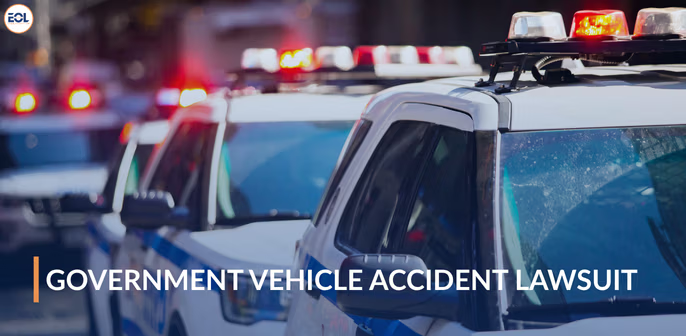
- Police cars.
- Transportation for board and commission members who travel a lot for their job.
- U.S. postal service vehicles.
- Other federal, state, county, or city vehicles.
Am I liable if I get in a car accident while driving a government vehicle?
If you figured in a car accident aboard a government vehicle, you must know that government employees are generally shielded from liability. This is true so long as they acted within the scope of their job when the car accident happened. In some instances, the immunity includes using a government vehicle to drive from and to their place of residence.
A government employee becomes liable for causing an auto accident when they acted outside the scope of their job. Consequently, certain behaviors after an accident, such as failing to call for medical assistance or leaving the scene, could also make you liable for the damages and losses in a government vehicle accident lawsuit claim.
In general, these scenarios will make you liable:
- If you are a civil servant that collided with another car while going for groceries using a government-owned vehicle.
- If you are a postal worker who did not call 911 after rear-ending a car mid-route.
On the other hand, you are generally not liable in these scenarios:
- If you are a city bus driver rear-ending another car as you drive out of a bus stop.
- If you are a police officer crashing against a building during a car chase.
The Federal Tort Claims Act safeguards individual government employees from personal liability when they act on behalf of the United States government. As long as their situation falls under FTCA guidelines, they are not liable.
10 steps to take when filing a government vehicles accident lawsuit
Take note of these steps should you ever find yourself involved in a crash with a government vehicle.
- Determine whether anyone is hurt or not.
- Call the police.
- Get immediate medical assistance.
- Gather all the important information about the accident, along with the witnesses’ names and contact details.
- Document the scene on your phone by taking photos and videos. This can help increase your chances of receiving maximum compensation in a government vehicle accident lawsuit.
- Avoid roadside discussions about the responsibility.
- Call a tow truck if necessary.
- Contact your insurance company.
- Check the proof of insurance card for instructions and keep accident-related documents in an organized manner.
- Connect with skilled, licensed, and experienced lawyers
How much compensation will I get?
When you file claims against the government, the amount of damages you can claim is often smaller compared to claims against private entities. If you already have insurance that covers some of your injuries, there are even higher chances that you would get a smaller compensation. This is because the amount you will receive gets deducted from the compensation that you will get in the lawsuit.
Moreover, the government primarily focuses on physical injuries. That means you need to prove the monetary value of the injuries you sustained through your medical bill or the repair costs of your damaged vehicle. Additionally, you will only get pain and suffering damages if you have a permanent bodily loss, such as a missing limb, disfigurement, or lost bodily function.
Note that in New Jersey, if you have medical bills of more than $3,600, you can easily qualify for pain and suffering compensation. However, other states will likely have a different rule under their own tort claims act.
Factors to consider when suing a government entity
Suing a government entity differs in many ways from a typical personal injury lawsuit, but they also share a few similarities. For instance, proving negligence is still vital to a successful claim against the government. Therefore, to prove liability in a crash with a government vehicle, you need to consider these factors:
- The defendant (a person or entity being sued) had a duty to act with reasonable care while performing official government duties.
- The defendant breached this duty in some way. It can either be by reckless action or inaction.
- The defendant’s negligence directly resulted in the plaintiff’s injuries.
If a government entity or employee injured you, you should fight for your rights without letting the thought of a legal battle with the government intimidate you.
Although it still depends on the state’s law, it is a general rule that no punitive damages may be recovered against the government. Also, there is no way you can claim higher than your initial request or claim unless you later raise and demonstrate that there is newly discovered evidence or intervening facts that are worth considering.
The statute of limitations for government vehicles accident claims
Before you institute an action versus the government under the FTCA, two things must concur: 1) you must have presented your claim to the federal agency who owned or operated the vehicle involved in the accident within six (6) months from the accident; and 2) the federal agency has denied your claim. This requirement is called exhaustion of administrative remedies.
The government entity has six (6) months to decide your claim. If the government rejects your claims, you will get additional six (6) months to re-file before you can file a federal lawsuit. Should the government not act on your claim within six (6) months, you have the option to treat the case as denied and commence your lawsuit before the courts.
Why hire a skilled, licensed, and experienced lawyer?
Because of the complex rules and deadlines involved in these cases, it is best to seek the legal advice of an experienced government vehicles accident lawyer who knows how to file a government vehicle accident lawsuit Against Government.
Moreover, from the victim’s perspective, it is very complex to file a lawsuit against the town, city, state, or federal government. A skilled personal injury attorney with years of experience handling these cases will try to help you get positive results in a timely manner. In most accidents, you have the right as the victim to sue the person who was negligent and caused your injuries in that party’s personal capacity.
When you are dealing with a government worker who was driving in the course of their duties when the accident happened, you might find it tricky to obtain damages from the defendant on your own. For this reason, it is always recommended to consult with a skilled attorney immediately. They will help you navigate the complex process, handle all the extra paperwork, file within deadlines, and deal with other special regulations.
What are you waiting for? Contact Ethen Ostroff Law now at 610-510-8883 ( by calling this number, you consent to receive SMS updates from Ethen Ostroff Law) or Submit Form to get free consultation and get your questions answered and sue the government for the crash. Then Ethen Ostroff’s team and network will ensure your case is handled as efficiently and urgently as possible.
